What we found auditing 100 UK Shopify stores
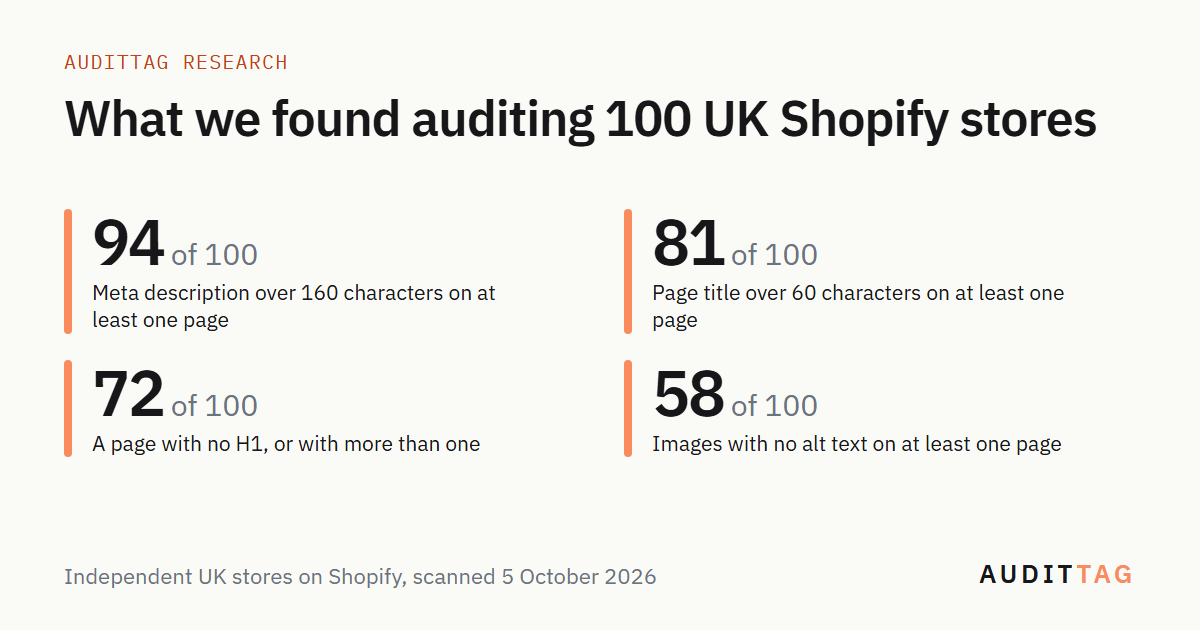
We read the public pages of 100 independent UK stores on Shopify on 5 October 2026. Every one had at least one of four basic on-page issues we checked for. 94 had at least one page with a meta description longer than 160 characters, 81 had at least one page with a title longer than 60 characters, 58 had at least one page with an image missing alt text, and 72 had at least one page with no H1 or more than one.
None of this is dramatic. But it says something about how small stores get set up, and a few of the tracking numbers further down are worth a look if you run one.
Who we looked at and how
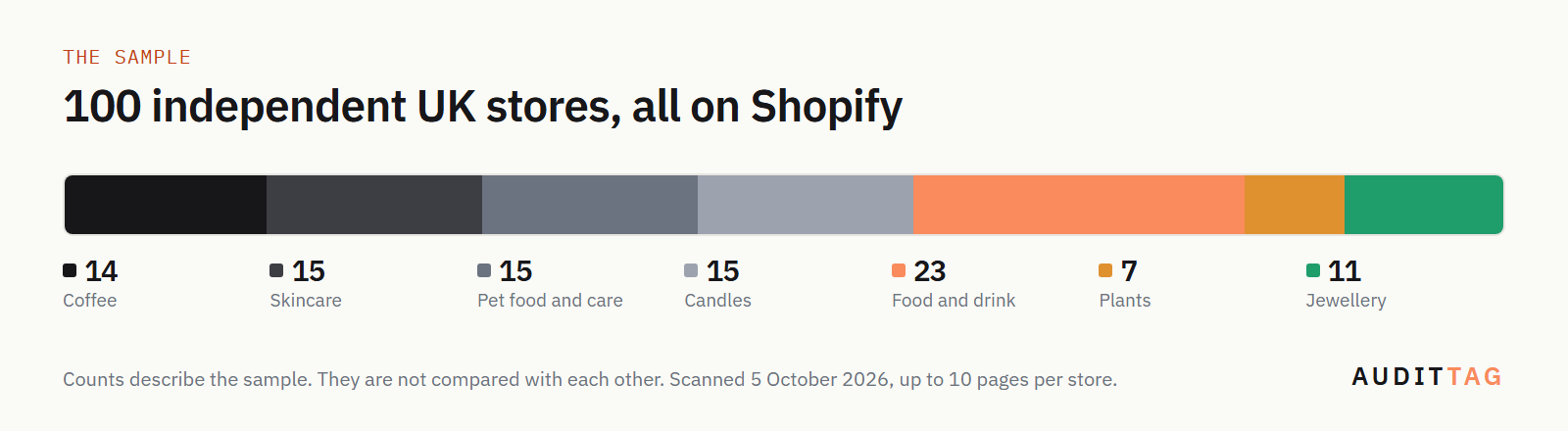
The 100 stores are independent UK shops in seven categories: coffee, skincare, pet food and care, candles, food and drink, plants and jewellery. Every one runs on Shopify. We found them through public lists and searches and kept the ones that were on Shopify and that our crawler could read.
We first picked 89 of them as stores that published a contact address, because we were looking for stores we could write to. The other 11, all jewellery stores, were added later and were not filtered that way. We took "independent" and "UK" from the lists and from each store's own pages, and we did not check the ownership of every store.
One store that was in the sample at the first scan refused our crawler on the final scan. We do not work around a refusal, so we dropped it and took the next store on our list in its place. The final sample is 100 stores.
On each store we read the homepage first, then pages in the order the store's sitemap lists them, then pages found by following links, up to 10 public pages in all. The median number of pages read was 10. All 100 were read on 5 October 2026 with the same crawler and the same checks as the free audit.
It is not a random sample and it is not "all Shopify stores". It describes these 100 stores on that day.
Four basic on-page checks
| Finding | Stores out of 100 |
|---|---|
| Meta description over 160 characters on at least one page | 94 |
| Page title over 60 characters on at least one page | 81 |
| Images with no alt text on at least one page | 58 |
| A page with no H1, or with more than one | 72 |
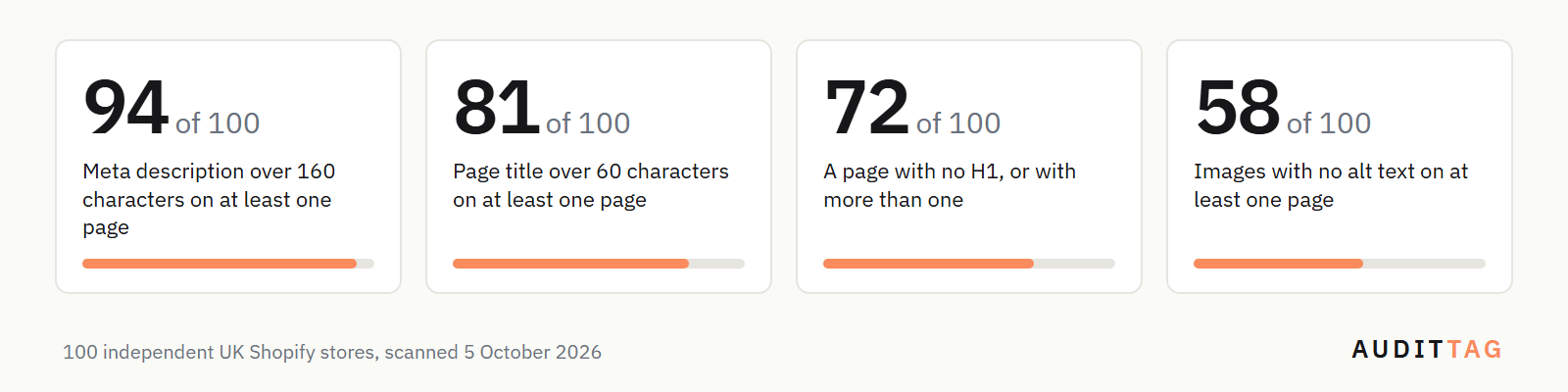
Every store had at least one of the four. The median store had eight different kinds of finding across all our checks, and the range ran from four to fifteen.
Meta descriptions
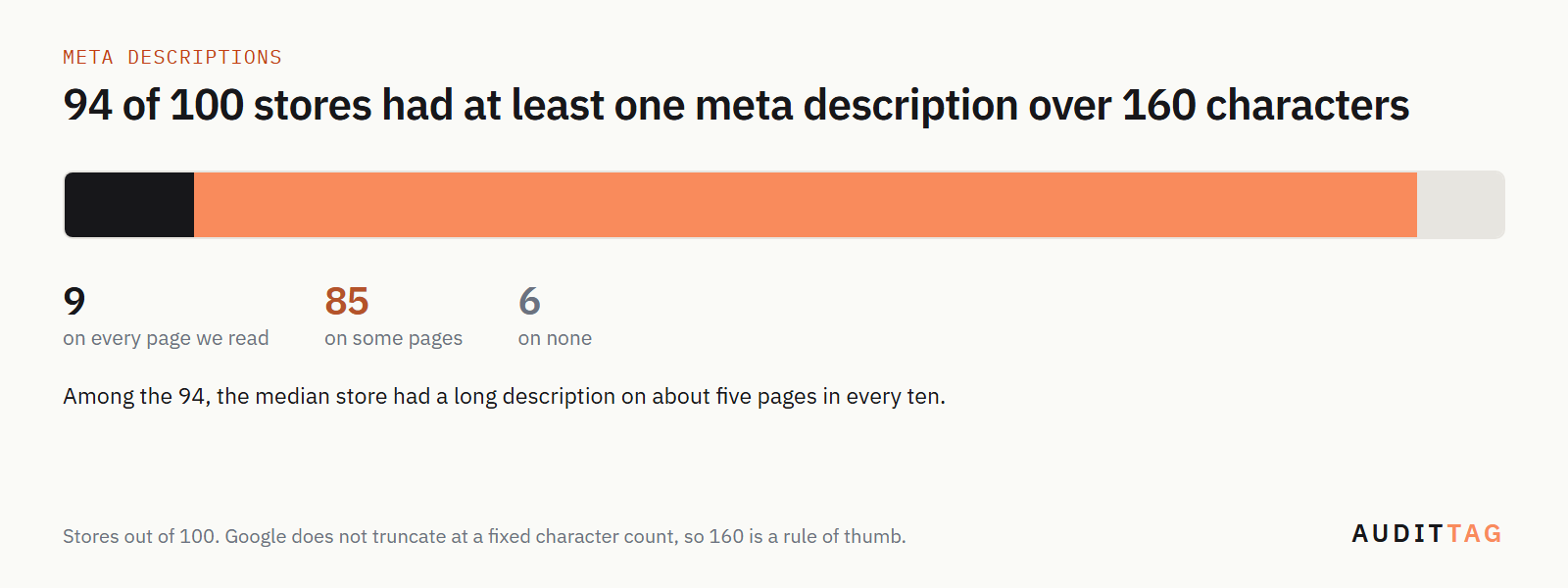
94 stores had at least one meta description over 160 characters. That is a useful rule of thumb, but Google does not truncate snippets at a fixed character count. Among the 94, the median store had a long description on about five pages in every ten we read, and 9 stores had one on every page we read.
The pattern suggests these descriptions are often generated systematically rather than written one at a time, although we cannot tell from outside whether the cause is a theme, an app, a template or something else.
Two honest points. Google rewrites a lot of snippets whatever you set, and the meta description is not a ranking factor. And 34 of the 100 had at least one page with no meta description at all, which leaves Google to build the snippet from whatever text it finds. Fixing a long one is a tidy-up. Filling an empty one is the more useful job. Our guide to Shopify meta descriptions covers how.
Page titles
81 stores had a title over 60 characters on at least one page. The median affected store had it on about four pages in ten, which is a similar pattern to the descriptions. A long title can be shortened in the results, and the end of it, often the brand or the useful word, is the part that goes.
Alt text
58 stores had at least one page with an image that had no alt text. Alt text matters for screen reader users first and for image search second, so this is as much an accessibility finding as an SEO one. A further 31 had alt text longer than the 125 characters our audit allows before it flags it. There is a walkthrough in Shopify alt text at scale.
Headings
72 stores had at least one page with no H1 or with more than one. 46 had at least one page with no H1 and 39 had at least one page with several, and 13 had both on different pages. We did not look into the causes. An H1 is useful for identifying the main subject of a page. Missing or multiple H1s are not automatically an SEO penalty, but they can point to inconsistent page structure and are worth checking.
Structured data
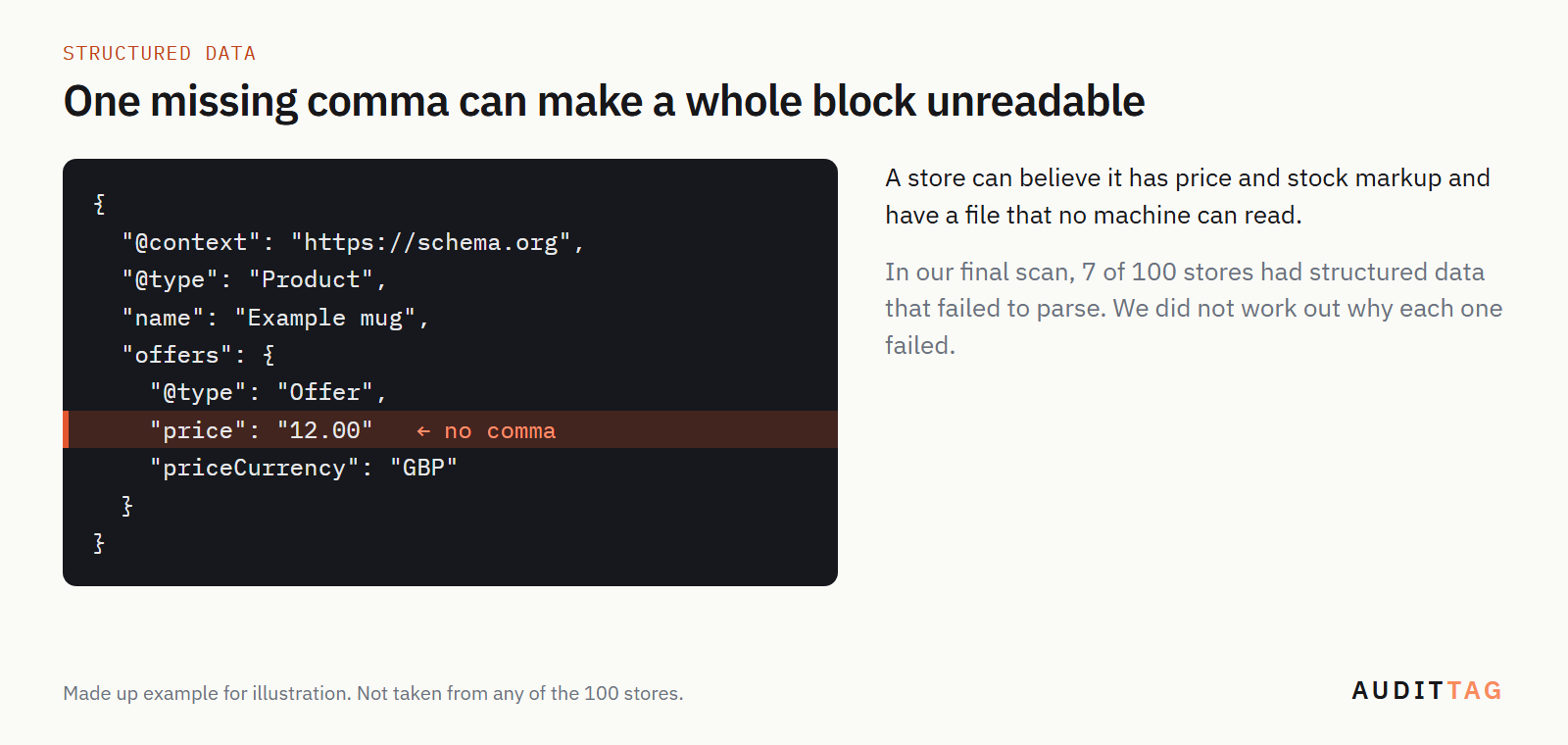
16 stores had product pages with no Product structured data that we could find, and 7 had structured data that failed to parse in our final scan. Of the six we re-read afterwards, five were Product markup and one was Organization and website markup. We did not work out why each one failed. A store can believe it has price and stock markup and have a file that no machine can read. See Shopify products missing prices and stars in Google.
Tracking, in the page source
We read tracking the same way every time. This is a check of what a page's source contains, not whether a tag fires, so everything here is a floor or a ceiling and is worded that way.
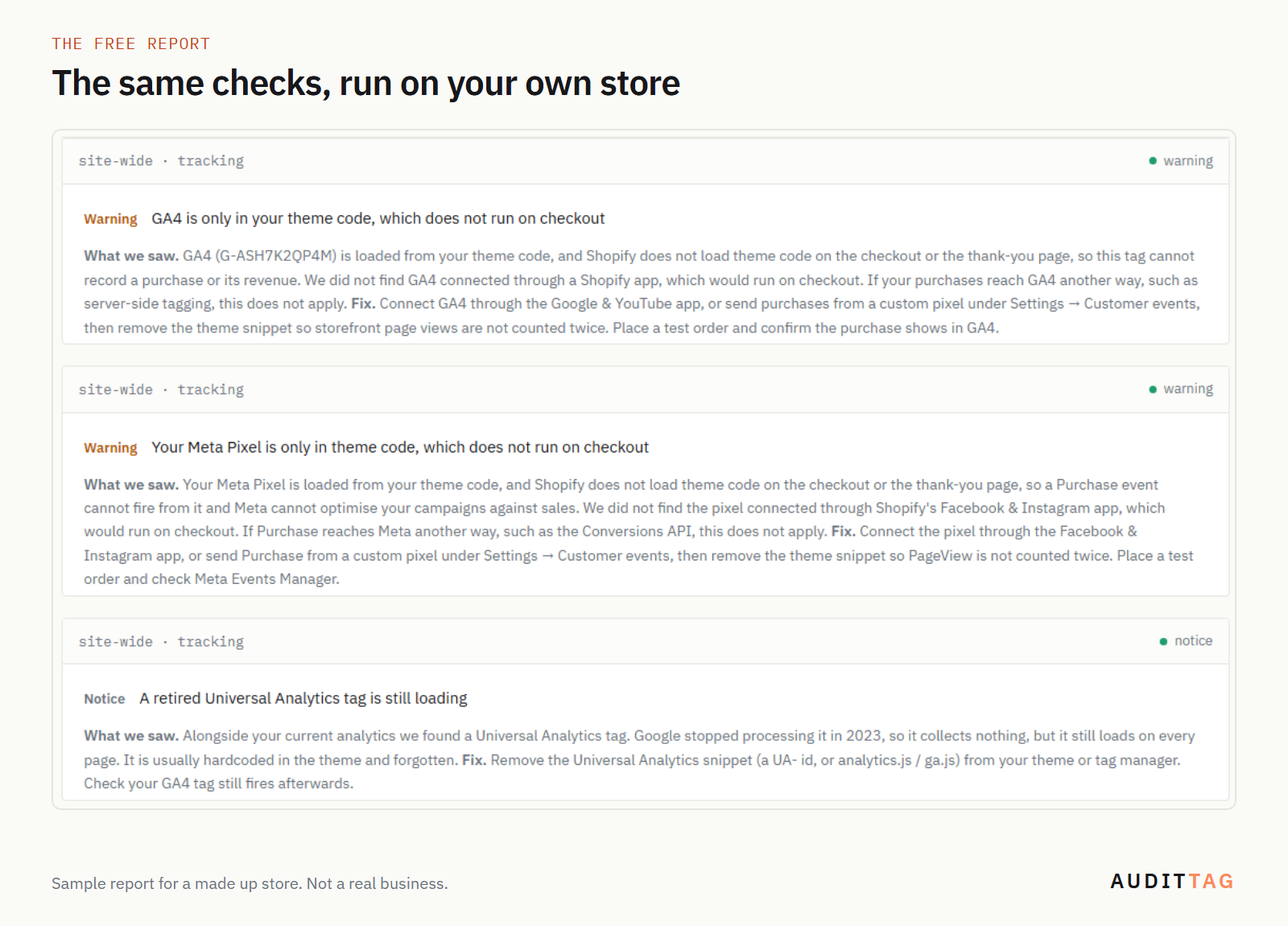
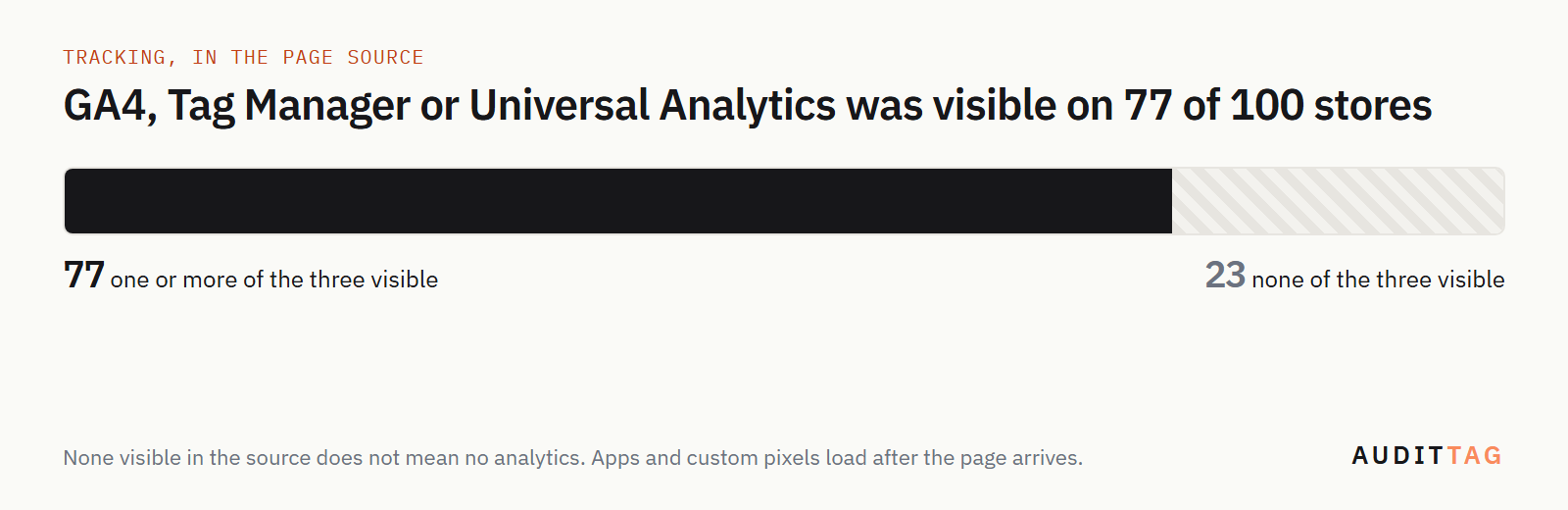
- GA4, Google Tag Manager or Universal Analytics appeared in the source on 77 of the 100 stores. The other 23 showed none of those three in the source we inspected. That does not mean they had no analytics, because Shopify apps, custom pixels and other setups may not be visible in the page source.
- 11 stores loaded GA4 from two places or under more than one ID, for example once in the theme and once through a Shopify app. Sometimes that is deliberate. In other cases it can be a leftover from an old app, a theme setup or an agency. We cannot tell which from the source alone. If both setups send the same page view to the same GA4 property, page views can be counted twice.
- 28 stores load Google Tag Manager from their theme. A container loaded only through theme code does not by itself provide coverage for Shopify checkout and post-purchase events, so this is something to confirm if the store relies on that container for purchase tracking. Shopify provides other ways to track events beyond the theme. We flag it as a thing to confirm, not a fault.
- Two stores still loaded Universal Analytics code, even though Google stopped processing Universal Analytics data in 2023.
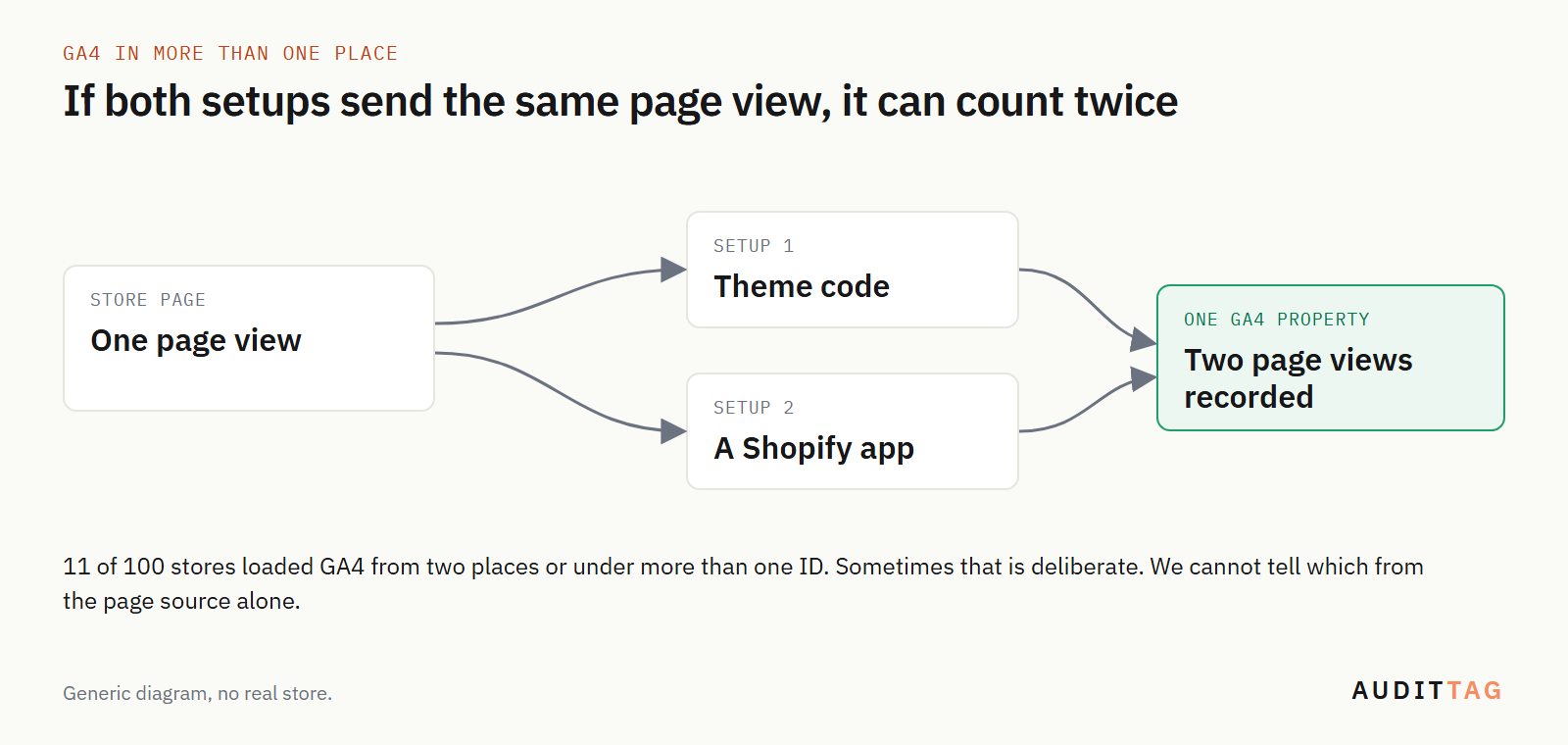
That is about page views. For the purchase side of double counting, see GA4 purchases counted twice on Shopify.
What this does not prove
- It does not show these problems cost anyone traffic or sales. Long snippets and missing alt text are worth fixing, but we have not measured any effect on ranking or revenue.
- It is not a random sample, and larger or less visible stores may look different. Eleven of the 100 are jewellery stores added separately, so category differences are not reported, since no category has 30 stores.
- It reads up to 10 public pages per store, so a store with thousands of pages is a sample of the store. A store counted as having a problem has it on at least one page we read. A store counted as clear may still have it elsewhere.
- It is a frozen snapshot. The figures are from one final scan, read between 20:24 and 20:35 UTC on 5 October 2026 with AuditTag detector build bc4a7f2, and a later AuditTag crawl may give different results. Pages, themes and sitemaps change, and which pages we read shifts with them. When we scanned 20 of the stores a second time hours later, 8 of 100 store results changed. Across the whole sample, comparing two full scans hours apart, the number of stores whose result changed on any one of the on-page findings quoted here ran from 1 to 18, while the tracking results did not change at all. Read each figure as accurate for that scan, not as a fixed property of the store.
- The 160 and 60 character limits and the 125 character alt text limit are the thresholds our audit uses. Google measures width, not characters, so some descriptions slightly over the limit show in full and some under it do not.
- The tracking numbers are presence checks. They cannot say whether a tag works, whether purchases are recorded, or whether a store has no tracking at all.
- No store is named. If you run one of the 100 and want it left out of future samples, email hello@audittag.com.
What AuditTag checks on your public pages
- Meta descriptions, page titles and headings
- Alt text on images
- Structured data that fails to parse
- Which tracking tags appear in the page source
What this doesn't prove
These counts show what the audit found on 100 stores in one scan. They do not show that a tag fires or that purchases are recorded, that any finding costs traffic or sales, or that the stores are typical of all online stores.
Want to see what we found on your store?
Run the same free AuditTag checks on your Shopify store. It takes about a minute and shows examples from your own pages. No account, no card, nothing to install, and it never changes anything on your store.
Run a free audit →